 English language
 Chinese language
 German language
 French language
 Greek language
 Spanish language
 Italian language
 Portuguese language
 Russian language
 Turkish language


So, you have found yourself in a situation where you need to learn French. Or perhaps it is not a necessity at all, but rather a heartfelt desire to fulfill a long-standing dream. Whatever the goal may be—professional development or the wish to feel free communicating while traveling in France—the question of strategy and, most importantly, the pace and prospects of quickly mastering spoken language becomes the main concern at the beginning of this journey.
“How long will it take to start speaking French?”
This question is the one teachers hear most often. The result depends on the correctly chosen tactics and the intensity of your work. Based on teaching experience, it can be said that you may begin speaking French within 9–12 months.
However, the first step is to overcome fear and begin taking active steps. Learning to speak French quickly is an achievable task if you build a well-structured learning plan.
Let us take a closer look at seven proven steps that can significantly speed up this process.
Step 1: Choosing Learning Materials — The Foundation of Future Results
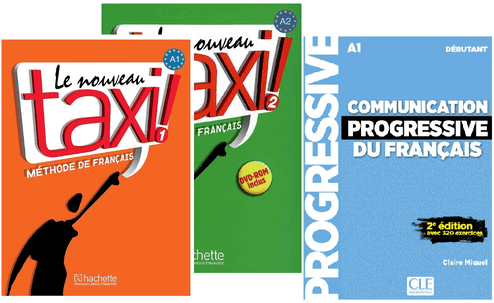
Any serious learning process begins with selecting a high-quality base. French as a Foreign Language textbooks (FLE), such as Le Nouveau Taxi, Alter Égo Plus, Tendances, Communication Progressive du Français, and Grammaire Progressive du Français, are specifically designed for adults learning French as a foreign language.
These course packages usually include the main textbook, audio materials, and a workbook with practical exercises. They can be downloaded online or purchased in bookstores and on various marketplaces.
Interactive exercises can serve as a useful addition—for example, those available on the TV5Monde platform. Working with such materials helps build a strong language foundation and allows you to progress systematically.
Once this foundation is established, you can move on to the next important stage—creating a language environment.
Step 2: Surround Yourself with French — Create an Immersion Effect
Immerse yourself in the sound environment of the French language as deeply as your circumstances allow. Play French radio in the background, watch films and TV series with subtitles.
Your goal is to get used to the sound of the language, its melody, and its intonation, even if you do not yet fully understand the meaning. This is a natural stage of learning.
When choosing materials, rely on your own interests. If you have a favorite French movie, watch it in the original language with subtitles in your native language. A familiar storyline reduces cognitive load and allows you to focus on the speech itself.
Once your ear begins to recognize familiar structures, it is time to move on to actively using the language.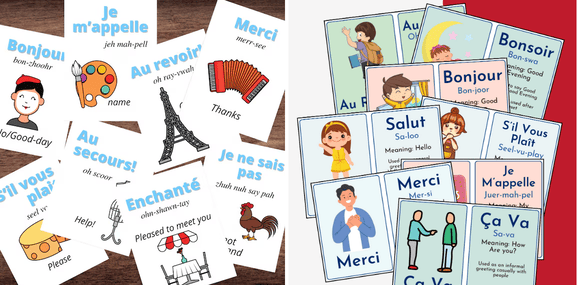
Step 3: Learn Basic Phrases — Start Speaking from the First Days
Start with something simple: create a list of basic “tourist survival phrases” such as “Hello,” “Thank you,” “Excuse me,” “Where is…?”
Learn the rules of politeness and the specifics of French speech etiquette. Every day, learn a new phrase and be sure to repeat it aloud.
After mastering short expressions, move on to dialogues in specific situations: in a restaurant, at a market, at the post office. The textbook Communication Progressive du Français is built around such real-life dialogues and helps adapt the language more quickly to practical circumstances.
Gradually, your vocabulary expands and your confidence grows.
Step 4: Use Visualization — Engage Your Imaginative Thinking
Reinforce new vocabulary visually. Create associative maps and connect French words with images of objects or specific situations.
Simple vocabulary cards can help increase your word stock, making the learning process easier and more effective. Organize vocabulary either by parts of speech or by thematic groups.
Place your notes somewhere visible—above your desk or in your notebook. Visual support significantly speeds up memorization.
The next step is to focus on the sound of the language.
Step 5: Work on Pronunciation — Develop Proper Articulation
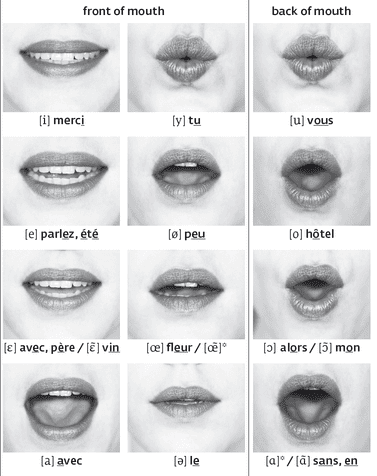
French has distinctive phonetic characteristics. Practice articulation exercises and pay attention to the specific features of French pronunciation.
Pronounce words slowly and clearly, imitating announcers or actors. Pay particular attention to sounds that do not exist in Russian, such as nasal vowels.
Films in the original language or other online resources can serve as good material for practice. Use a mirror, record yourself on audio or video, and analyze your pronunciation in order to improve it.
For the best results, create a comfortable learning environment by limiting external distractions.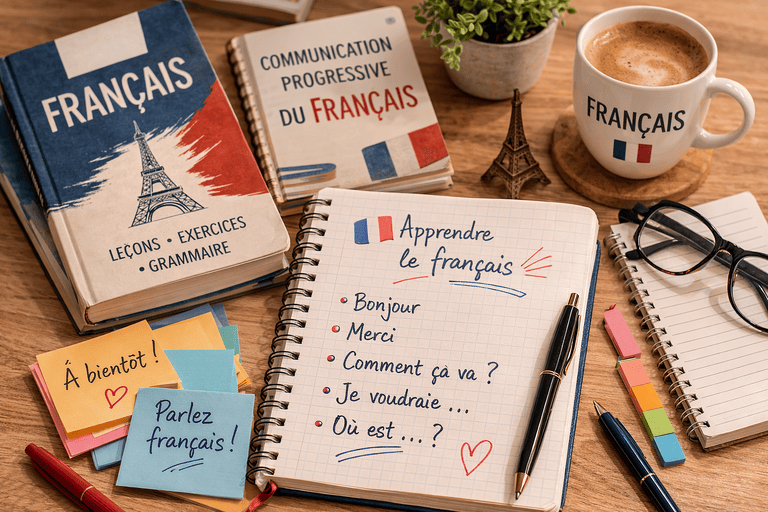
Step 6: Alternate Types of Activities — Maintain Motivation
To avoid monotony and keep your interest alive, alternate different types of activities: reading books, watching videos, writing dictations, and listening to songs.
Such varied practice helps develop several aspects of the language at the same time and supports internal motivation.
Create your own study schedule and try to follow it consistently. This builds structure and discipline, which are especially important at the initial stage of learning.
And finally, we arrive at the key step without which it is impossible to reach a confident conversational level.
Step 7: Speak with Native Speakers — Move to Real Practice
Communication with French speakers provides a powerful boost to the development of speaking skills. Find a language partner on specialized platforms such as InterPals or HiNative.
Let your first conversations be short and simple. Gradually, as your level improves, make the topics more complex and expand your vocabulary.
Live practice breaks the language barrier and transforms knowledge into a real communication skill.
Learning with a Teacher
Independent study requires discipline and time. However, under the guidance of an experienced teacher, progress becomes more structured and noticeable.
At the online school Skype-Language.com, both Russian-speaking teachers of French and native speakers work with students. This allows learners to combine clear explanations of complex grammar in Russian with real conversational practice.
An individual approach, a flexible schedule, and a systematic methodology help students overcome the language barrier faster and begin speaking even at the early stages of learning.
Remember that starting to speak quickly requires effort and patience. Success comes to those who practice regularly and enjoy the learning process itself.
Your journey into the world of the French language is open—enjoy every new phrase and every small victory. And if you need professional support along the way, the teachers at Skype-Language.com are always ready to help make this journey more confident and productive.