 English language
 Chinese language
 German language
 French language
 Greek language
 Spanish language
 Italian language
 Portuguese language
 Russian language
 Turkish language

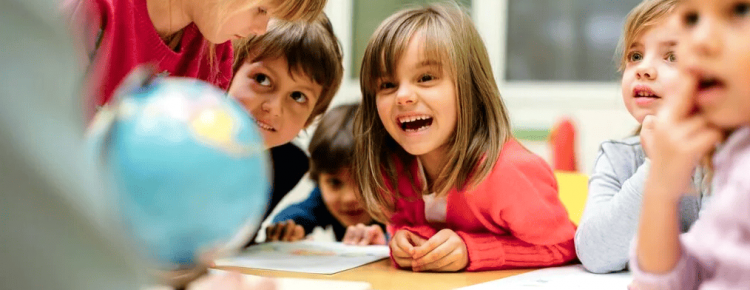
Psychologists say that among basic human emotions the feelings of surprise and interest are most closely connected with human development and the speed of adaptation in the world. For a person to live fully and for their energy not to run out, they must regularly experience this emotion. Surprise helps us notice changes and not be afraid of them, stimulates interest in new knowledge and supports personal growth. On the contrary, without interest emotions fade, depression approaches, and the desire and ability to act disappear.
Since the process of any learning is the discovery of something new and the acquisition of skills, and this requires effort and overcoming oneself, it is therefore very important in learning to strengthen this emotion of interest.
In foreign language textbooks, at the end of each section one can often find tasks intended for entertainment — “For fun” — so that we can experience pleasant emotions, relax a little and have some fun. After all, the rest of the time we must painstakingly work on the material and then complete rather dry exercises, applying the knowledge we have gained.
But why is “For fun” placed at the end of the section?
Is it something like a reward for the work done? Like a candy, chocolate, or ice cream? My teaching experience shows that it is better to start with “entertainment” right away — at the beginning of a lesson, a topic, or a section.
I have come to the conclusion that for children knowledge itself is not as important as emotions and impressions. What matters to them is not WHAT we are going to study — the alphabet, words, or phrases — but HOW we study it.
I will explain this using the example of lessons with younger schoolchildren. (pic 1).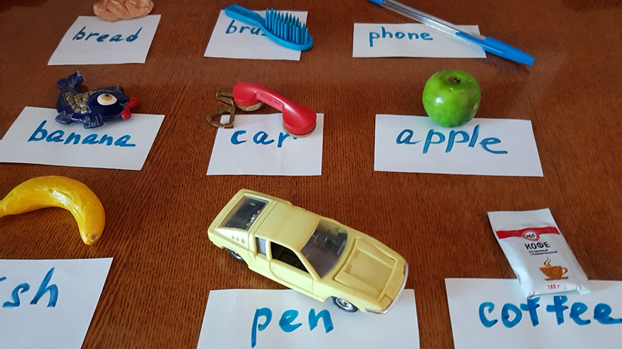
In front of the student, small toys and objects are laid out on the table. Under them there are pieces of paper with the names of objects, but not these particular ones — other objects that are also lying on the table. In other words, everything is mixed up. The task is to match the correct names with the objects. Such a task always causes a lively reaction from young students.
What are the reasons for this excitement?
- First, small toys and objects are very familiar to children. The task deceptively seems very simple, and they want to complete it as quickly as possible.
- Second, children are conservatives and like to put things in order in what they already know.
- Third, the task contains intrigue and a kind of mystery, and this “starts up” the child and stimulates their cognitive interest.
With older students the task can be modified. For example, portraits of famous personalities can be placed on the table and quotes with their statements can be placed underneath them, again mixing up the authorship. The student must match the quote with the person shown in the portrait who actually said it.
How can students learn the alphabet and letters and also remember the spelling of basic words? I suggest using cut-out cards with the letters of the alphabet. I ask a very young student to write all the words he or she already knows (usually there are only a few), and an older student, for example, to write the word “apple.” Students find this much more interesting than writing a traditional dictation. (pic 2).
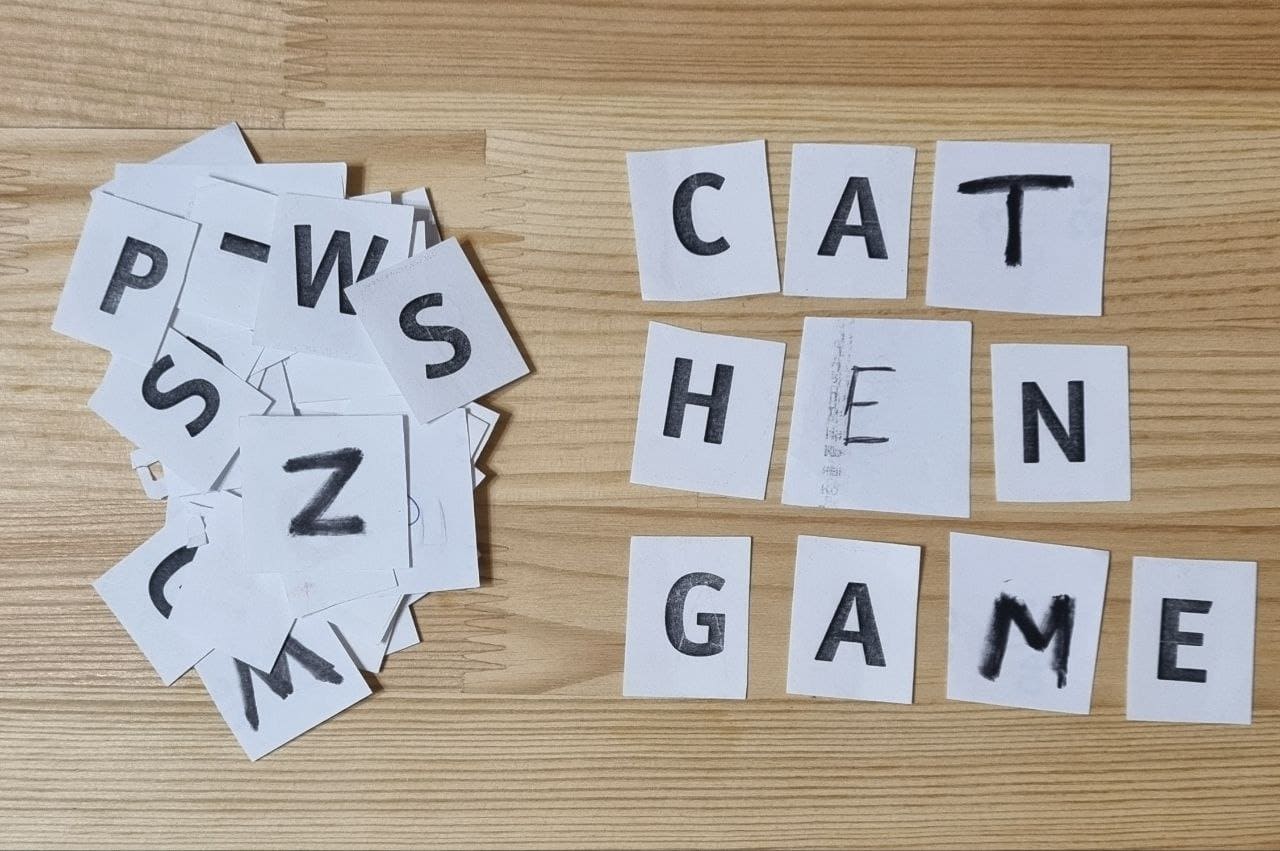
Then I complicate the tasks. I ask them to insert missing letters into familiar words while looking at cards with pictures of the corresponding objects (pic 3).
In later lessons we can use the same cards to write phrases such as “It’s a red kite.” “It’s a green apple.”
I have discovered that such impression-based tasks help to solve several educational goals at once. I will list them and illustrate them with examples from my own teaching experience.
- Impression-based tasks increase motivation.
They are designed in such a way that the child can be successful when completing them. Motivation for learning and for acquiring new knowledge depends greatly on success in the subject.
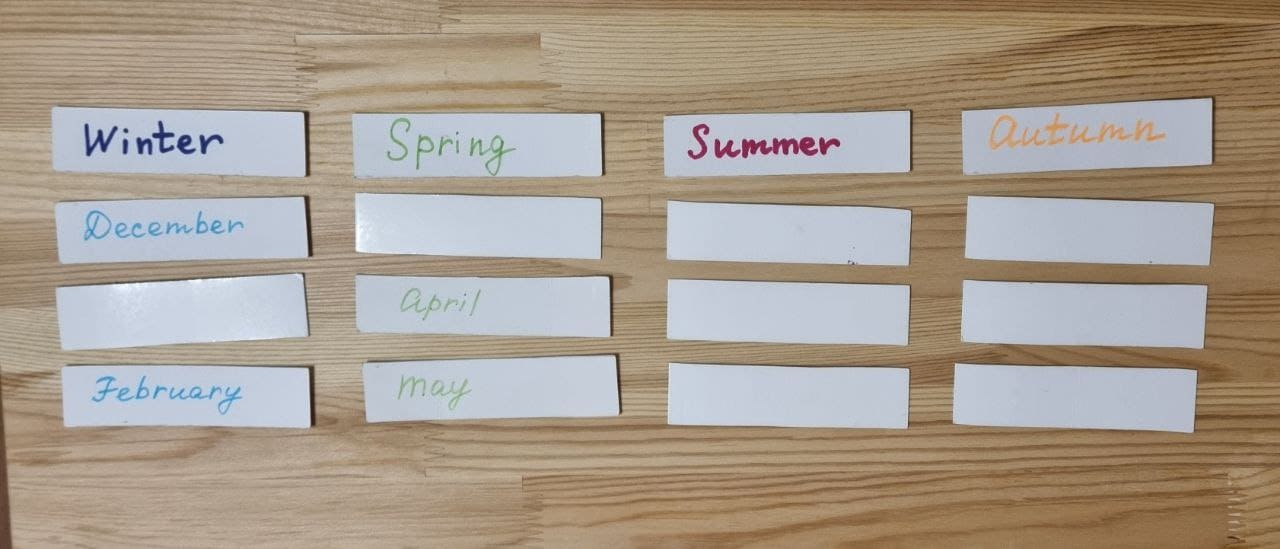
Example. The task “Months and Seasons.” (pic 4).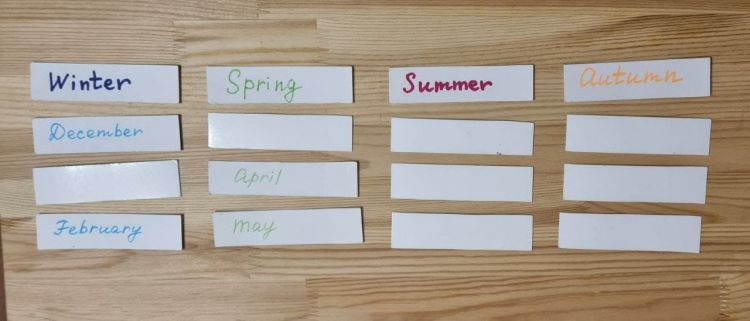
It is suitable for students who have previously studied this topic. Cards with the names of seasons and months are placed on the table face down. The student must recall the names of the months and, by turning over the cards, discover whether they remembered correctly or not. As a result, the full list of months should be formed. (pic 5).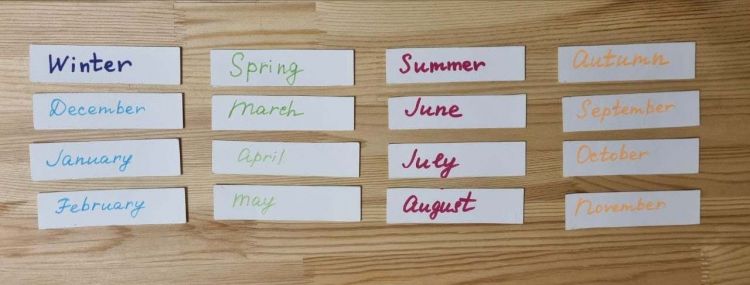
- Impression-based tasks are visual.
For example, students need to learn personal pronouns and possessive adjectives.
We take dolls. Each doll on the table represents a certain personal pronoun. The pronouns “I” and “You,” as well as “We,” are represented by the teacher and the student themselves. Near each doll a certain object is placed that “belongs” to it. Next to this object we place cards with possessive pronouns. This visual representation helps the student remember the pronouns and also understand what words like “his,” “her,” “their,” and so on mean. As it turns out, understanding the meaning of such words is not so easy for younger schoolchildren.
This scheme can be used to perform a series of exercises to practice the topic. First the student names what belongs to whom, and then the cards are removed and the student tries to say it without prompts. For example: It’s my car. It’s his phone. It’s her fish, and so on (pic 6).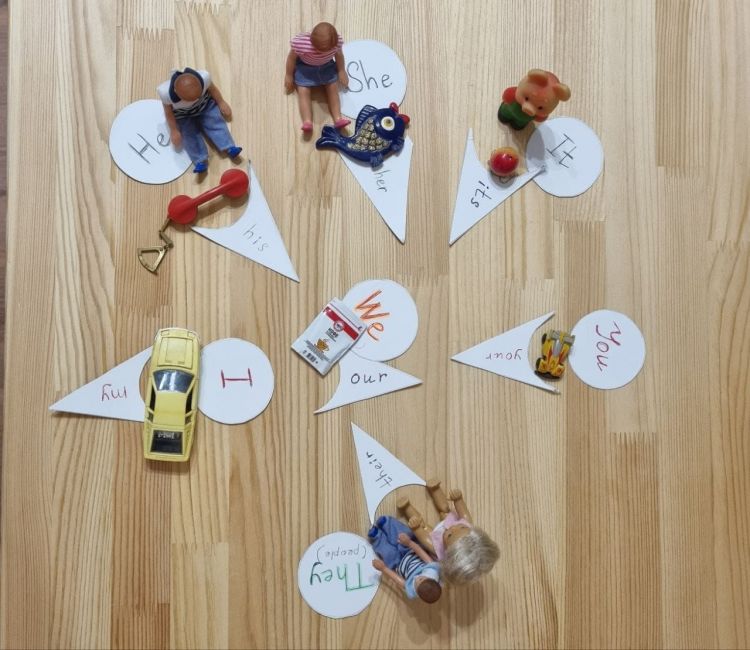
- Impression-based tasks are systematic and methodical.
My students really like cards with numbers. You need to connect the parts from which numerals are formed. In the process of this work the student can clearly see how numerals from 13–19 and from 20–90 are constructed (pic 7).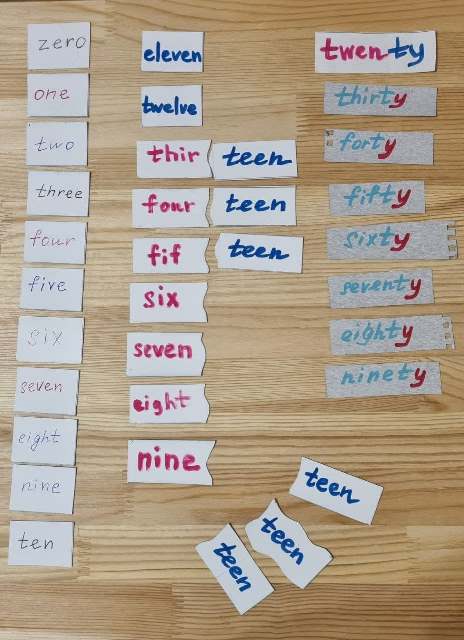
- Impression-based tasks increase interest and give positive emotions.
Most students respond very well to tasks in which they need to say something about themselves: about their tastes, interests, friends. These can be short statements such as “I like apples. I hate vegetables,” as well as small compositions or a game played together with the teacher called True/False. For example, I try to guess the student’s tastes: You like tea. You don’t like coffee. The student then answers whether it is True or False.


I use the child’s interest in themselves, their friends, and their family members to explain complex topics. To learn the comparative and superlative forms of adjectives, I ask them to say who in the class is the tallest, strongest, or smartest. Usually while forming such statements I notice personal emotions regarding certain classmates and how this motivates children to construct sentences. I observe a much greater readiness to work than when we complete standard exercises that are not connected with the student’s own experience.
Sometimes I even use a student’s resistance to doing certain tasks to my advantage. For example, one of my students does not like doing written assignments. I ask her to say this in English: “I hate it. I hate doing writing.” Statements about “oneself” are always easier than talking about someone else. At the same time the word “hate” is learned, which is already useful.
One might think that all my lessons consist entirely of such tasks. In reality, it often happens that after an emotional introduction to a topic we can move on to more traditional exercises, which the student then completes with much greater involvement, both intellectually and psychologically. So I wish you to find such approaches and techniques that allow you to surprise and impress your students — both children and adults.
If you want to try such tasks in practice and personally see how emotions and impressions increase interest and motivation in learning English, I invite you to take lessons at the online school Skype-Language.com. Here, you will be able to apply the method of impressions in practice and make learning vivid, engaging, and effective.